
Understanding Mountain Pine Beetles in Black Forest
Black Forest is currently experiencing a growing mountain pine beetle outbreak in ponderosa pine forests. Many residents are noticing fading trees, pitch tubes, woodpecker activity, and increasing tree mortality across the area.
One of the biggest challenges during beetle outbreaks is that many people remove the wrong trees at the wrong time. Understanding when trees were attacked, which trees currently contain developing beetles, and how forest structure affects wildfire and ecosystem health is critical to making informed decisions.
This page is intended to help residents understand:
- The mountain pine beetle timeline
- How to identify infested trees
- What should be removed
- What can wait
- Why some dead trees should remain
- How forest health and wildfire mitigation work together
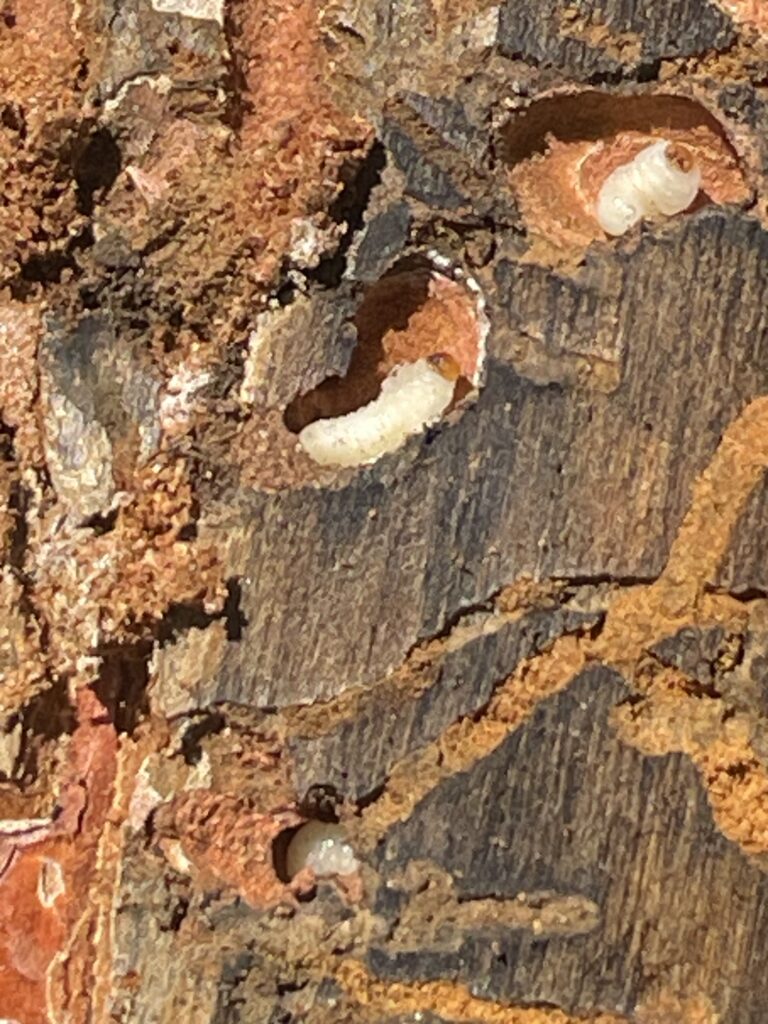
Mountain Pine Beetle Larvae and Galleries
Mountain pine beetle larvae developing beneath the bark within feeding galleries created during a 2025 infestation.
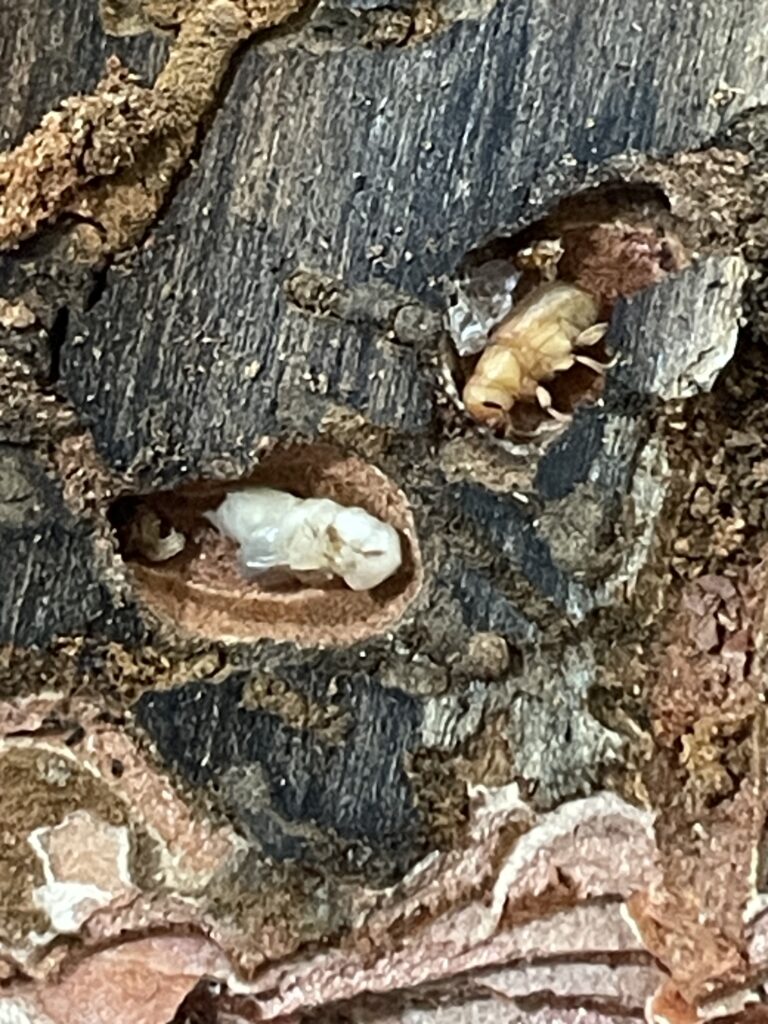
Mountain Pine Beetle Development Stages
A mountain pine beetle larva (bottom) and newly formed adult (top) developing beneath the bark inside their pupal chambers.
Adult Mountain Pine Beetle
An adult mountain pine beetle beneath the bark of an infested ponderosa pine tree.
The Beetle Timeline
Mountain pine beetles operate on a multi-year cycle.
A tree that looks dead today was usually attacked the previous year.
That means:
- Trees fading red or orange in 2026 were generally attacked in 2025
- Trees attacked during 2026 may still appear mostly green this summer
- Beetles developing beneath the bark right now are expected to emerge later this year
This timing is important because mitigation efforts are most effective before new beetles emerge and fly to surrounding trees.
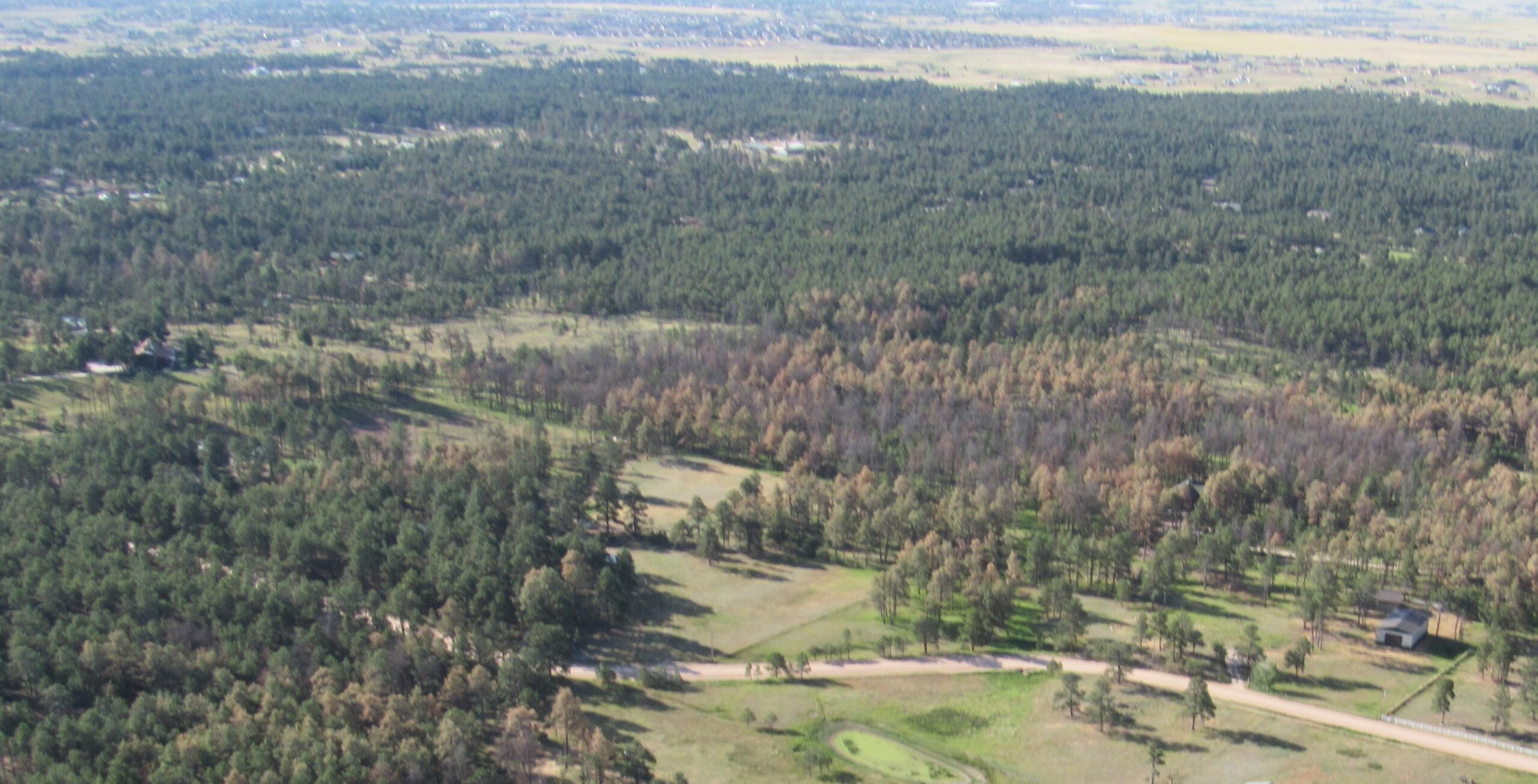
Expanding Forest Mortality in Black Forest
Mountain pine beetle outbreaks can spread across large areas over multiple years. This aerial view shows widespread tree mortality and fading ponderosa pines within the Black Forest area as the infestation continues to expand.
Why Timing Matters
The current window for slowing beetle population growth is short.
Before Mid-June
This is the most effective period to:
- Identify recently infested trees
- Remove infested trunkwood
- Dispose of infested material before beetle flight intensifies
At that point, infested wood may need to be:
- Chipped
- Ground
- Buried onsite
- Otherwise contained locally
After Mid-June
Mountain pine beetle flight activity is expected to increase significantly.
Once flight season intensifies:
- Transporting infested wood is generally discouraged
- Freshly cut pine can attract additional beetles because of sap and pitch odors
- Certain cutting activities may unintentionally worsen spread
Mountain pine beetle management is seasonal, and strategies that are appropriate in winter or spring may not be appropriate during summer flight season.
Understanding the Maps
Each year, the USDA Forest Service and Colorado State Forest Service conduct aerial detection surveys across Colorado forests.
These surveys identify:
- Fading trees
- Areas of mortality
- Expanding beetle infestations
The maps are extremely useful for understanding regional outbreak patterns, but they can also be misunderstood.
Aerial surveys typically detect trees that are already fading from attacks that occurred during the previous year.
For example:
- Trees mapped as “faders” in 2025 were usually attacked in 2024
- Newly infested green trees may not yet appear on the maps
This means ground-level inspections are still critical for identifying currently infested trees.
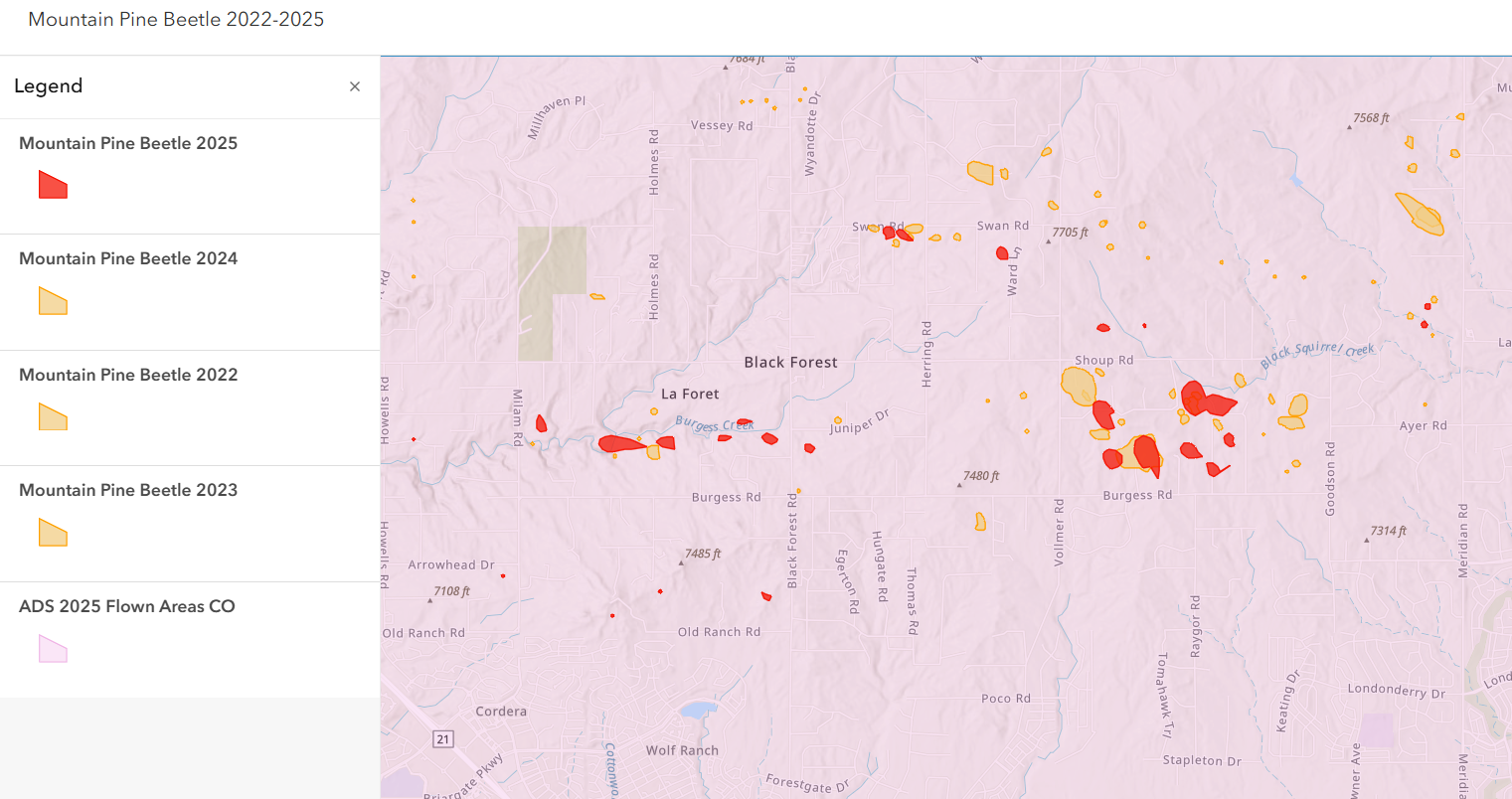
Mountain Pine Beetle Activity in Black Forest (2022–2025)
This USDA and Colorado State Forest Service aerial detection survey map shows expanding mountain pine beetle activity in portions of the Black Forest area from 2022 through 2025. Orange polygons represent earlier years of detected “fader” mortality, while red polygons show trees identified during the 2025 survey season. Because aerial surveys detect fading trees, most mapped areas represent infestations that actually began the previous year. Newly infested green trees may not yet appear on the map.
Explore the Interactive USDA Beetle Map
USDA Aerial Detection Survey Map Viewer
This tool allows residents to:
- Zoom into Black Forest
- View mapped mortality areas
- Compare infestation patterns over time
- Better understand the scale of the outbreak
Identification
What Trees Should Be Removed Right Now?
The highest priority trees are generally:
- Trees still green but already infested
- Trees beginning to fade or wilt
- Trees with hard brown pitch tubes
- Trees with blue-stained wood beneath the bark
These trees may still contain developing beetles preparing to emerge later this season.
The goal is to interrupt the next generation before flight begins.
Pitch Tubes
Pitch tubes are one of the clearest signs of mountain pine beetle activity.
Hard Brown Pitch Tubes
Hard, dried pitch tubes usually indicate older attacks where beetles are already developing beneath the bark.
These trees are often priority candidates for removal before flight season.
Fresh Pink or Sticky Pitch Tubes
Fresh pink, cream-colored, or gooey pitch tubes may indicate a very recent attack.
Some of these trees may survive. Others may become next year’s fading trees.
At this stage:
- Blue stain fungus may not yet be present
- Beetles may still relocate to nearby trees
- Removing lightly attacked trees does not always stop spread
Blue-Stained Wood
Mountain pine beetles carry a fungus commonly called blue stain fungus beneath the bark.
When blue staining is visible in trunkwood, it usually indicates:
- Beetles successfully colonized the tree
- Beetle development is underway or recently completed
- The tree is unlikely to recover
Blue-stained trunkwood is the material that should be prioritized for removal or proper disposal before beetle flight intensifies.
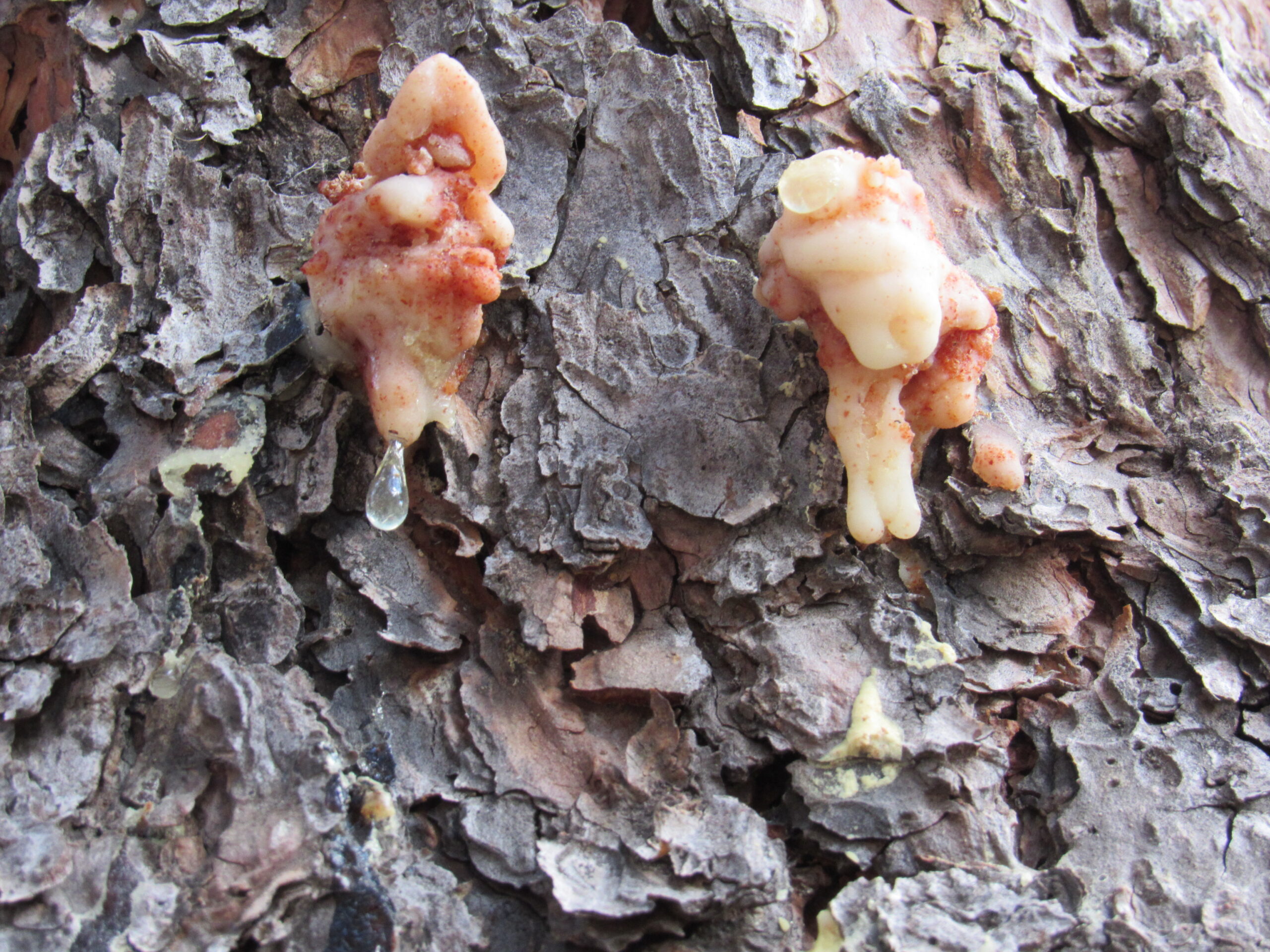
Fresh Pitch Tubes
Fresh, light-colored pitch tubes with visible sap indicate a recent mountain pine beetle attack. These trees may still appear healthy and green but are often the next generation of potential beetle-killed trees.
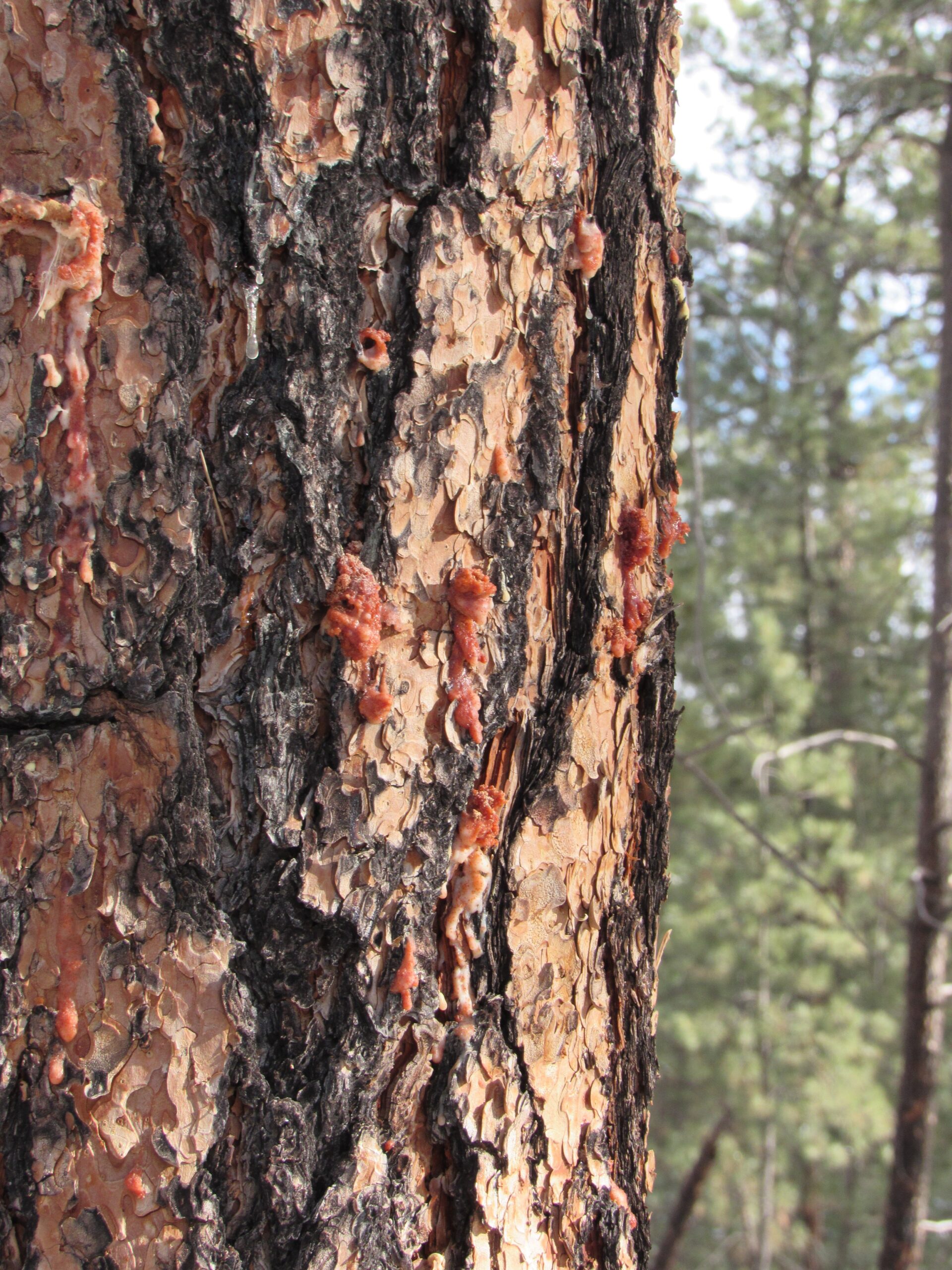
Pitch Tubes on an Attacked Tree
Pink and reddish pitch tubes are signs of a mountain pine beetle attack. These soft, sticky tubes are created when the tree pushes sap outward in an attempt to defend itself from invading beetles.
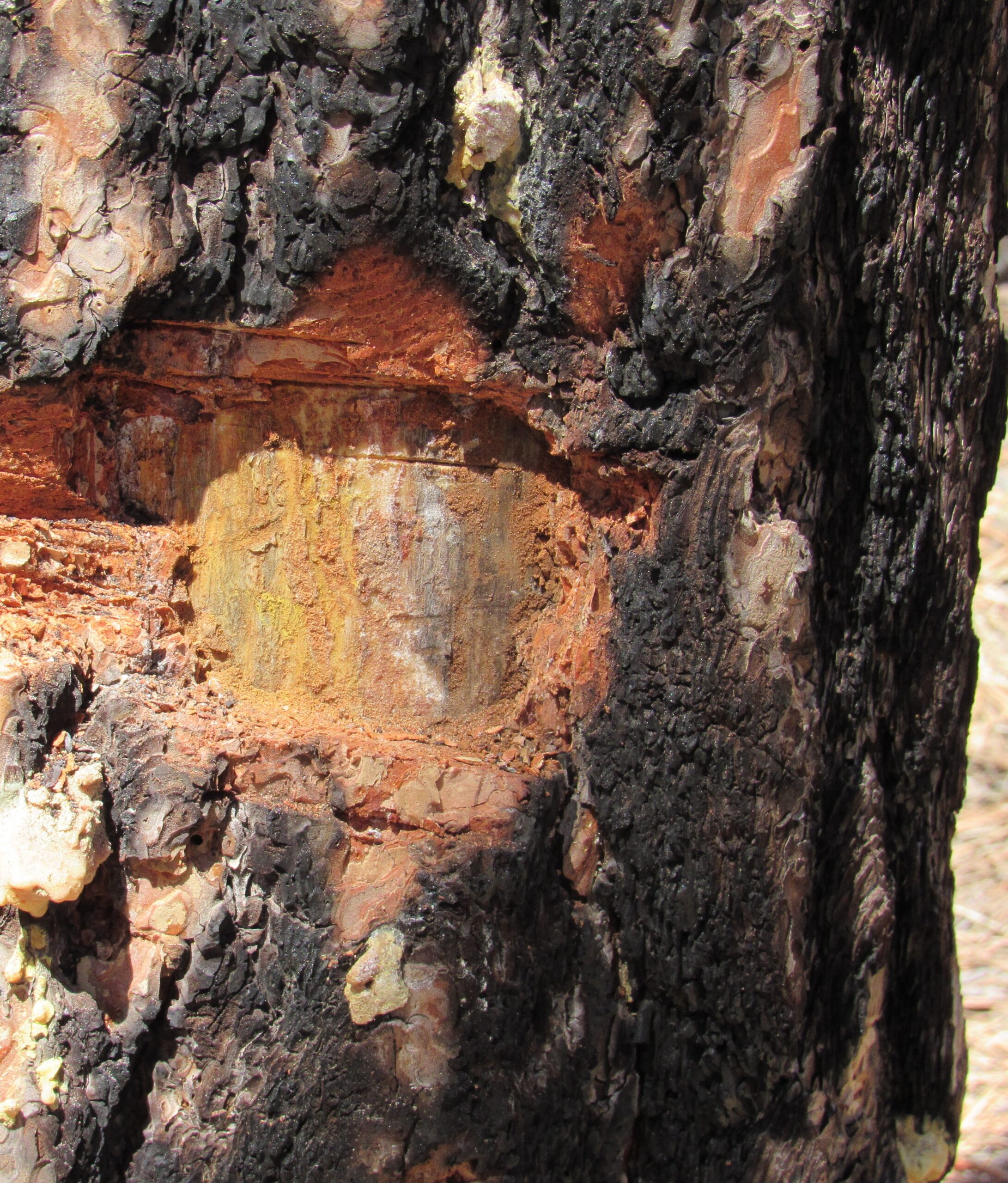
Bark Removed From an Infested Ponderosa Pine
Removing sections of bark can reveal beetle galleries, boring dust, and blue-stained wood beneath the surface. These signs help confirm active or recent mountain pine beetle infestation.
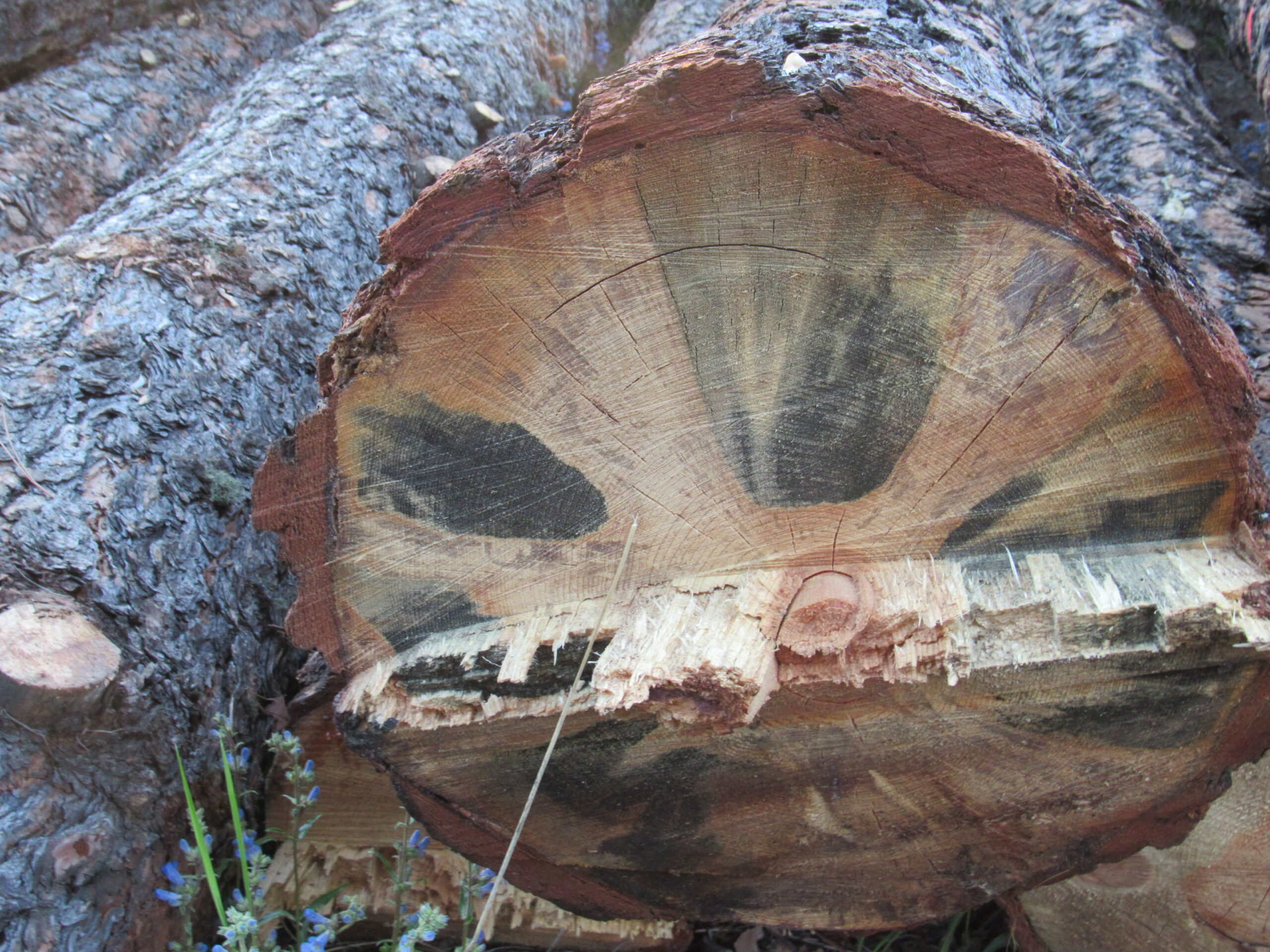
Blue-Stained Wood Inside an Infested Tree
Dark blue and gray staining in the trunkwood is caused by blue stain fungus carried by mountain pine beetles. Trees with blue-stained wood often contain developing beetles beneath the bark and should be prioritized for removal before beetle flight season.
Common Misconceptions
“All Dead Trees Should Be Removed”
Not necessarily.
Some standing dead trees, also called snags, provide valuable wildlife habitat and may remain standing for decades in appropriate non-hazard locations.
Woodpeckers feed on wood-boring insects within dead trees and help create nesting cavities used later by:
- Bluebirds
- Nuthatches
- Swallows
- Other cavity-nesting species
Many of these birds also consume bark beetles and other forest insects.
In areas away from structures, roads, and access routes, retaining some wildlife trees may support long-term ecosystem health.
What Material Actually Matters?
One common misconception is that all slash material contains mountain pine beetles.
In reality, mountain pine beetles primarily live beneath the bark of larger trunkwood.
They are generally not found throughout:
- Needles
- Small branches
- Slash piles
Most branches and slash can often be taken later to slash and mulch sites for grinding.
The highest concern is infested trunkwood with active beetles beneath the bark.
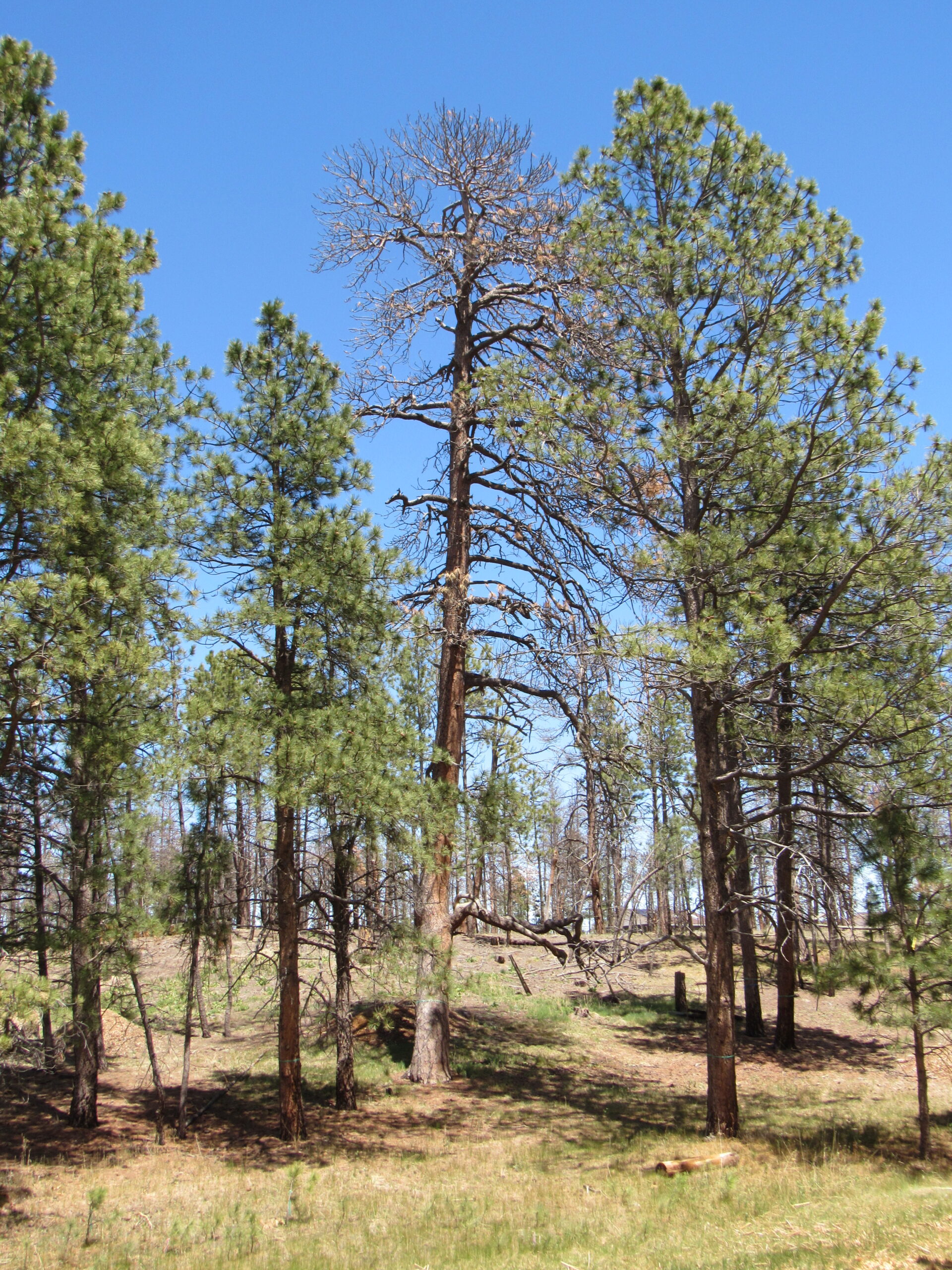
Standing Dead “Wildlife Tree”
Not every dead tree needs to be removed. In non-hazard areas, some standing dead trees, also called snags, can provide important habitat for birds, insects, and wildlife. Hazard trees near homes, roads, or structures should still be evaluated for removal.
“Cutting More Trees Always Improves Forest Health”
Forest health is more complex than simply removing trees.
Healthy forests often contain:
- Diverse spacing patterns
- Clumps and openings
- Different age classes
- Wildlife habitat
- Reduced understory crowding
Thoughtful thinning strategies can improve:
- Wildfire resilience
- Forest health
- Wildlife habitat
- Long-term ecosystem stability
Forest Health and Wildlife Habitat
Standing dead trees can provide important habitat for decades.
Over time:
- Woodpeckers excavate cavities
- Wood softens and decays naturally
- Additional birds and wildlife move in
- Insects help recycle nutrients back into the ecosystem
In some forest management approaches, retaining at least several wildlife snags per acre is recommended where safe and appropriate.
This is especially applicable in areas where dead trees already exist from previous mortality events.
The Outbreak Is Still Expanding
The current outbreak has been building locally since approximately 2020.
At this time, the infestation is concentrated primarily within portions of Black Forest, but beetle activity has also spread into:
- Falcon Fire Protection District
- Areas near Tri-Lakes
- Additional portions of eastern El Paso County
Mountain pine beetle outbreaks can expand rapidly once populations increase.
Without early identification and management of newly infested trees, outbreaks may continue growing across the region.
Mountain Pine Beetles and Long-Term Forest Restoration
Mountain pine beetle management is not a one-season project.
Long-term forest resilience involves balancing:
- Wildfire mitigation
- Defensible space
- Forest density
- Wildlife habitat
- Ecosystem health
- Future forest regeneration
The goal is not simply to remove trees, but to create healthier, more resilient forests over time.
About the Contributor
The information, field observations, photographs, and educational materials on this page were generously provided by Judy von Ahlefeldt, a longtime Black Forest resident, naturalist, and forest ecology educator with decades of experience studying ponderosa pine ecosystems, wildfire behavior, mountain pine beetles, wildlife habitat, and forest restoration in the Black Forest region.
Judy has spent many years documenting local forest conditions, beetle activity, vegetation patterns, wildlife habitat, and ecological changes across eastern El Paso County. Her work emphasizes long-term forest health, defensible space, ecosystem resilience, and the importance of balancing wildfire mitigation with wildlife habitat and restoration goals.
The photographs and educational information shared throughout this page are based on field observations and monitoring conducted in Black Forest from 2020 through 2026 and are used with permission to support public education and community awareness.